Metabolomics · Multi omics · Mass spectrometry
Each month we feature one new paper from the lab. You get the big idea in plain words, a key figure, and a link to the full paper.
November 2026 · Ecological Indicators
Soil chemistry warns of permafrost collapse years before we can see it
Permafrost peatlands can look healthy right up until they collapse. By then it is too late to act. Ben Yang and the team asked a simple question. Can the molecules in soil tell us a change is coming? The answer is yes.
2 to 7 years
earlier warning than visible collapse
10 years
of soil samples from Stordalen Mire in Sweden
4,932
molecules tracked in every sample
Chemistry sees it first
Most monitoring relies on what we can see. Plants shift. The ground sinks. Ponds appear. These signs show up only after the ecosystem has already changed.
Metabolomics reads the chemistry of the soil itself. It captures thousands of small molecules made by plants and microbes. Together they form a chemical fingerprint of how the ecosystem is working right now.
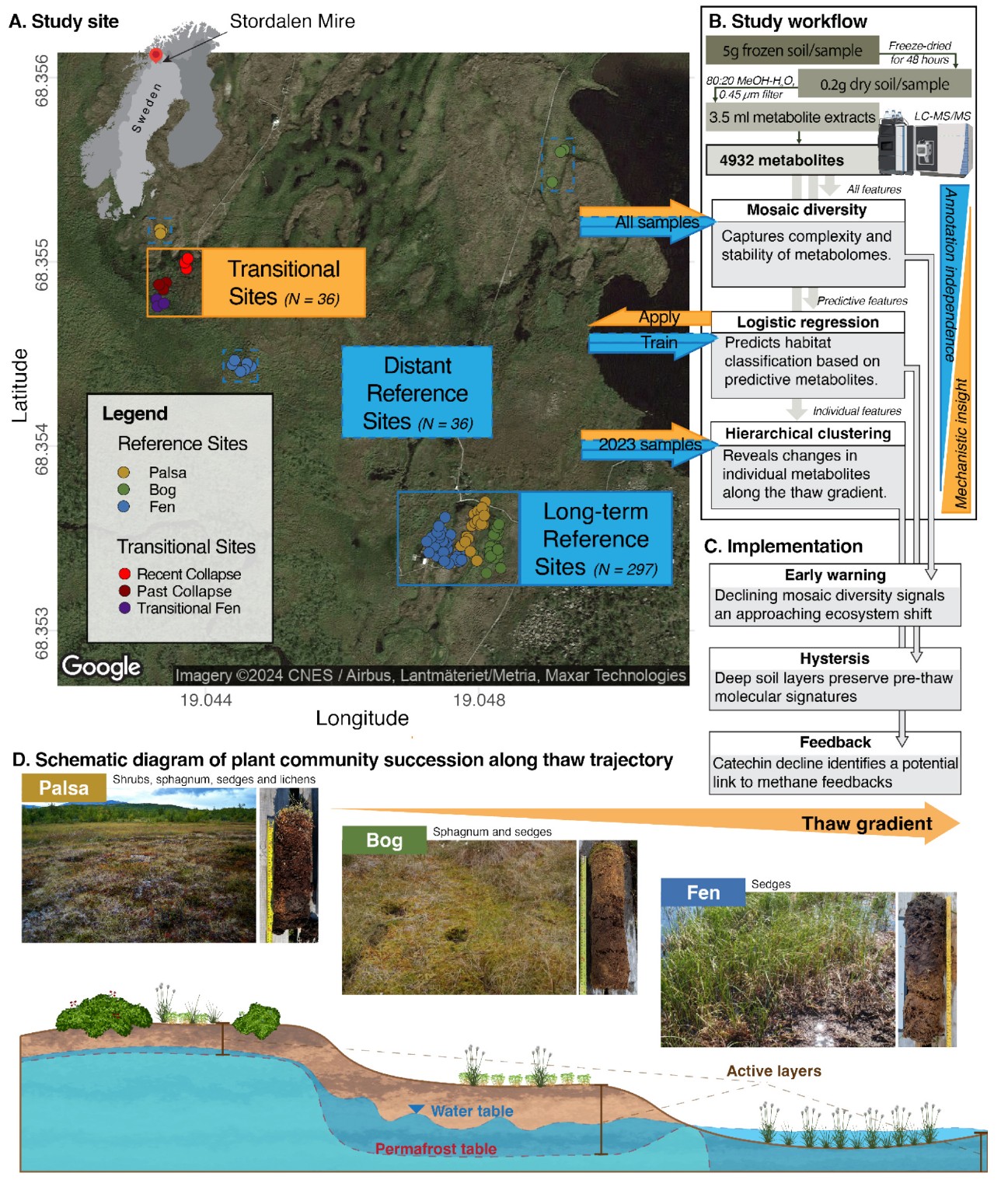
Healthy palsa soil had a rich and varied chemical landscape. As thaw approached, that variety dropped and the soil chemistry became simpler. This drop showed up 2 to 7 years before the palsa collapsed at nearby sites. Air and soil temperatures stayed stable over the decade. The signal came from the ecosystem itself and not from one warm year.
Three signals in the soil
- Early warning. A drop in chemical diversity flags an ecosystem on the edge.
- Hidden memory. Deep soil keeps its old palsa chemistry even after the surface thaws. Thaw moves in layers and not all at once.
- A methane link. Catechin is a natural compound that slows methane production. It declines as thaw moves forward. Losing it may help more methane escape.
A new tool for watching ecosystems
This work turns untargeted metabolomics into simple indicators that scientists and land managers can track. The team also built a model that reads the chemical fingerprint of a soil and tells how close it is to palsa, bog, or fen. Metabolomics can now act as a chemical early warning system. The same approach could be tested in wetlands, forests, and other places facing climate stress.
Team
Ben Yang (first author), Gretchen Hall, Viviana Freire-Zapata, and Malak Tfaily from the Tfaily Lab, with Lawrence Walker, Ruth Varner, Rachel Wilson, and the EMERGE field team.
Yang B, Hall G, Freire-Zapata V, Walker LR, EMERGE Field Team, Varner RK, Wilson RM, Tfaily MM. 2026. Metabolomic indicators anticipate permafrost peatland ecosystem transition before visible change. Ecological Indicators 192, 115709.

